
Sustainable Development
The Sustainable Development Goals were established in 2015 by the United Nations General Assembly and are set to be achieved by 2030. They are a set of 17 interconnected global goals designed to be a "blueprint for a better and more sustainable future for all.
The Social Development Bank works to achieve a number of sustainable development goals that revolve around financial inclusion, equal opportunities, supporting innovation, industry and infrastructure, creating economic opportunities, and enhancing economic growth for the individual. They enhance social welfare by supporting low-income groups and people with special needs, in addition to empowering women, reducing discrimination, supporting sustainability and providing services to cities and governorates, in addition to activating and building partnerships with the public and private sectors in a way that contributes to and accelerates the achievement of the Bank's development goals.
Social Development Bank's contributions to achieving sustainable development
The Bank contributed to achieving 9 out of 17 Sustainable Development Goals.
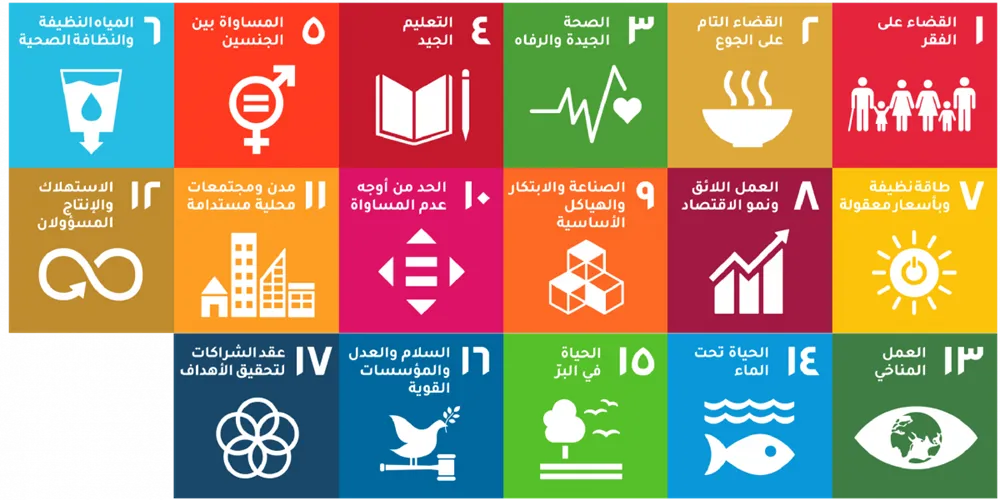
General principles of sustainable development strategy
Empowering the community
- Supporting citizens with limited and low income
- Promoting and spreading the culture of entrepreneurship and supporting entrepreneurs
- Raising the contribution of the non-profit sector to the GDP
- Raising family income savings
The main axes for achieving sustainable development in the bank
- Empowering the community
- Empowering social security families/entrepreneurs/women through developing income-generating economic projects.
- Providing interest-free social financing to citizens with limited and lower incomes for the purposes of marriage, restoration, and bearing the burdens of family life.
- Supporting special groups and families most in need through financing programs directed to families of prisoners, orphans, widows, abandoned women, and the indigent.
- Raising and enhancing the contribution of the non-profit sector to the GDP
- Providing qualitative financing programs for entrepreneurs to support industries suitable for the capabilities of the nation's young men and women.
- Promoting the culture of financial management and savings among all segments of society.
- Developing savings products that suit all segments of society in cooperation with partners in the private sector.
- Non-financial support programs by providing a package of non-financial services and programs (rehabilitation, integration, training, guidance and awareness).
The main objectives of the Bank's sustainable development strategy
- Empowering entrepreneurs and generating new job opportunities through the following initiatives:
Masarat Program, through the following tracks:
- Startup Track:
It targets small projects and aims to provide job opportunities for all segments of society, especially entrepreneurs.
- Excellence Track:
It targets economic sectors in which the bank’s financing priorities are achieved to the greatest extent possible, and whose cost exceeds 300,000 ♦ .
- Existing projects track:
It targets financing existing small and medium enterprises that achieve profits that qualify them for growth, in order to help achieve the desire of their owners to expand and spread.
- Increasing the contribution of the non-profit sector to the GDP, through:
- Tamkeen Program:
Which aims to activate the role of associations and institutions in the transition from direct pastoral work to broader development work by building internal units responsible for providing microfinance services (financial and non-financial) to support beneficiaries towards carrying out micro-economic activities that reduce their dependence on care and guarantee services, and enabling associations and civil institutions to manage microfinance loan portfolios and support productive families and micro-enterprises and build their capacities.
- Estdama Program:
It is a financing program for associations, civil institutions and non-profit committees in the Kingdom, aiming to motivate and push them towards financial sustainability by providing good financing programs and non-refundable grants to these entities so that they can own endowments or investments that provide them with a fixed income and enable them to diversify their sources of income.
- Improving and increasing the percentage of women practicing income-generating economic activities, through the path of micro-projects and productive families.
- Increase family income savings and spread the culture of saving, by launching the following initiatives and programs:
- Financial Culture and Savings Awareness Campaign Project:
Which aims to spread the culture of saving and increase financial awareness among members of society, especially young people. - Savings Program Implementation Support Project:
Which aims to design a savings product for the bank’s clients that is compatible with the provisions of Sharia and directly linked to social financing.
- Financial Culture and Savings Awareness Campaign Project:
- Support for low- and low-income people, through:
- Providing interest-free social financing to citizens with limited and lower incomes for the purposes of marriage, restoration, and bearing the burdens of family life.
- Creating financing programs for special categories: with the aim of targeting new segments of society that were not previously covered by the bank's services and products.
- Linking marriage financing to obtaining a qualifying course: with the aim of contributing to reducing divorce.
- Maintaining and correcting data on financing grants and collection for social financing: with the aim of raising the level of data quality and collection
- Building strategic partnerships with government agencies and the non-profit sector: to ensure that financing amounts reach those who deserve them.
- Guidance, counselling and training, through:
Dulni Business Center
Last Modified Date 03/06/2026 - 4:51 PM Saudi Time